
How Long Does It Take to Build an Office Building in the UK?
How long does it take to build an office building? About 16 months on site for a 4-storey, 4,000 m² office, and 17 to promise. Choosing steel over concrete makes almost no difference to that date. The envelope and the M&E risers decide it, and on a typical start date 2 of the packages that drive the finish are already late before anyone arrives on site.
Steel or concrete fills a lot of design meetings. On the end date, it barely registers.
We ran the same office through our free construction programme generator twice: 4,000 m² over 4 storeys, shell to fit-out, once with a reinforced concrete frame and once with steel, starting on site on 26 October 2026 in the South of England. Office durations in the generator rest on our own practitioner norms for floor cycles and commissioning, not a published dataset, so treat them as a well-informed starting point.
| Frame | Plan | Likely finish (P50) | Promisable finish (P80) |
|---|---|---|---|
| Reinforced concrete | 12 Jan 2028 (63 weeks) | 7 Mar 2028 (71 weeks) | 30 Mar 2028 (74 weeks) |
| Steel | 12 Jan 2028 (63 weeks) | 7 Mar 2028 (71 weeks) | 31 Mar 2028 (74 weeks) |
1 day apart.
The steel frame goes up in about 4 working days a floor against about 7 for concrete, and finishes about 2 weeks sooner. Then both buildings wait for the same thing.
What actually sets the finish of an office build?
The envelope. The rainscreen starts at the end of March 2027 and runs for about 12 weeks. The building is not weathertight until 21 June 2027, week 34, whichever frame holds it up. Every internal trade waits for that date.
Here is the concrete-frame office, stage by stage.
| Stage | Finishes | Week |
|---|---|---|
| Site set-up, investigation and piling mat | 25 Nov 2026 | 4 |
| Rotary piling | 7 Jan 2027 | 10 |
| Pile caps, ground beams and ground floor slab | 8 Feb 2027 | 15 |
| RC frame, four floors and roof slab (steel: 8 Mar) | 24 Mar 2027 | 21 |
| Roof and rainscreen envelope: weathertight | 21 Jun 2027 | 34 |
| Risers, plant rooms and fit-out to static completion | 2 Nov 2027 | 53 |
| Commissioning: flush, balance, BMS, integrated systems tests | 23 Nov 2027 | 56 |
| Certificates, fire safety information, O&M and handover | 12 Jan 2028 | 63 |
| Buffer to the promisable handover | 30 Mar 2028 | 74 |
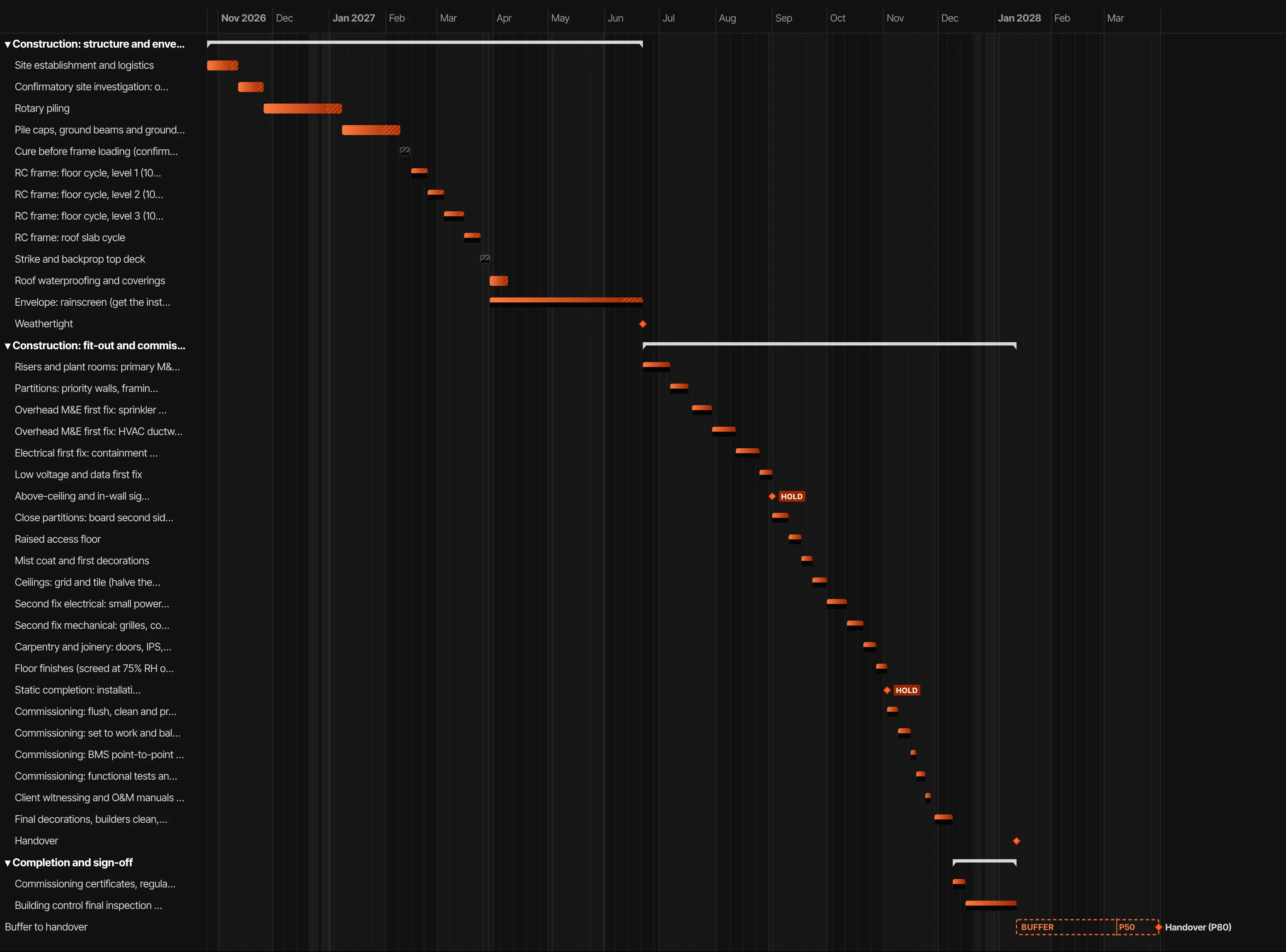
If you want an office faster, put your effort into the envelope design, the cladding package and its installer’s real output rate. Ask for that rate in writing.
The cladding installer’s output rate is the most important number in an office building. Get it in writing.
Why are some packages late before you start?
Because their lead times are longer than the time between award and need. The generator works back from when each package is needed on site to the latest date it can be ordered. On a 26 October 2026 start:
| Package | Lead time | Needed on site | Order by |
|---|---|---|---|
| Risers and plant rooms: primary M&E and main LV switchboards | 36 weeks | 22 Jun 2027 | 13 Oct 2026 |
| Rotary piling | 5 weeks | 26 Nov 2026 | 22 Oct 2026 |
| Steel frame (steel option) | about 12 weeks | 15 Feb 2027 | 23 Nov 2026 |
The first 2 dates fall before the start on site. That is common, and it is usually the first thing driving the end date. The fix is simple to say: place the order at award, under a letter of intent if needed, or ask the client to buy direct. Then move the activity to the delivery date the supplier commits to, so the programme shows the real end date, not the one you hoped for. Lead times in the generator are a market snapshot checked in October 2026, so confirm each one with the supplier.
How long does it take from the decision to build to handover?
For the concrete-frame office:
| Route | Already done when the clock starts | Start on site | Promisable handover (P80) | Total |
|---|---|---|---|---|
| Construction only | Design, planning, approvals and contractor in place | 26 Oct 2026 | 30 Mar 2028 | 17 months |
| Traditional, single-stage tender | Design complete to RIBA Stage 4 | 16 Mar 2027 | 11 Aug 2028 | 22 months |
| Design and build from Stage 4 | Employer’s Requirements written | 21 Jun 2027 | 13 Dec 2028 | 26 months |
| Two-stage design and build from Stage 3 | Concept design only | 15 Feb 2028 | 12 Dec 2029 | 38 months |
The two-stage route carries a major planning application. The statutory period is 13 weeks, but only 19% of major applications in England were decided within it without an agreed extension in the third quarter of 2025 (LandTech, from MHCLG data). The generator allows about 26 weeks.
Does a bigger office take much longer?
Longer, but not in proportion. A 2,000 m² 3-storey office comes out at a P50 of 10 November 2027 (54 weeks) and a P80 of 25 November (56 weeks). Doubling the floor area to 4,000 m² adds about 17 weeks, not 54. Taller buildings add floor cycles, envelope and riser work faster than area alone suggests: run your own size in the generator rather than scaling these.
How long does an office fit-out take?
For 1,000 m², the generator gives:
| Work | Likely finish (P50) | Promisable finish (P80) |
|---|---|---|
| Light fit-out, Cat A to Cat B, one floor | 24 weeks | 24 weeks |
| Heavy refurbishment: strip to shell and re-service, two floors | 49 weeks | 51 weeks |
Heavy refurbishment is driven by discovery. The asbestos survey and opening-up findings change the scope, which is why the generator lets their slow cases run to 2.5 times the likely duration. On light fit-outs, landlord consents and out-of-hours working are the hidden durations. Put them on the programme, not in the risk register.
Why does the commissioning take so long?
Because it is a stage, not a trade. CIBSE Code M separates static completion, when the installation is physically complete, from commissioning, which has its own programme time: flush and pressure test, set to work and balance, BMS point-to-point, then integrated cause-and-effect testing. The generator sets commissioning at about 8% of the construction chain even on small schemes. Programmes that fold it into the M&E trades find it again at the end, on the critical path.
What makes office builds run late?
- Long-lead M&E. Main LV switchboards and primary plant at 36 weeks, ordered late.
- The envelope. An installer rate guessed rather than committed.
- The ground. Piling obstructions and contamination found in the confirmatory investigation.
- Commissioning squeezed. Treated as the M&E contractor’s last week rather than its own stage.
- Fire-stopping. The above-ceiling and in-wall sign-off before closing in is a hold point. Photograph everything.
In the last UK industry survey of its kind, for 2019/20, about 60% of projects finished on time (Glenigan and CITB, via Construction Plant News). The industry has known for decades that the programme is where jobs go wrong. Our long read on construction’s biggest cause of delay explains why it keeps happening.
If you’re about to start an office job, check the order-by dates before you check anything else. If they have already passed, you know your first problem.
Reading the order-by dates, holding the envelope installer to a committed rate and giving commissioning its own stage are skills, not luck. They are what we teach in Going for Gold, our construction project management programme.
Frequently asked questions
How long does it take to build an office building in the UK?
About 16 months on site for a 4-storey, 4,000 m² office, with about 17 months as the date to promise. From the decision to build, allow 22 months to 3 years depending on the route.
Is a steel frame faster than concrete?
On the frame, yes: about 4 working days a floor against 7. On the finish, barely: in our example both give a P50 of 7 March 2028, because the envelope sets the date.
How long does an office fit-out take?
About 24 weeks for 1,000 m² of Cat A to Cat B fit-out, and about a year for a heavy strip-out and re-service.
What is the longest lead time on an office build?
Usually the primary M&E and main LV switchboards, at about 36 weeks. Order them at award.
What is a construction programme for an office?
A sequenced plan of every activity, with durations, dependencies, hold points and order-by dates, ending in a buffer to the date you can promise. The generator builds one in under a minute.
Build your own office programme
The free construction programme generator builds the whole programme: Gantt chart, P50 and P80, buffer, hold points and order-by dates that tell you which packages are already late. Change the frame, floor area, storeys, route or start date and it rebuilds. Download it for Excel and keep it.
The frame is the part everyone argues about. The envelope is the part that decides.
The bottom line: order the long leads at award, get the cladding rate in writing, and give commissioning its own time.
More in this series: how long does it take to build…
a primary school? · a house? · a leisure centre with a pool? · a secondary school?
Sources
- Free construction programme generator v2.9: every duration, date and order-by date. Runs made 26 Oct 2026: RC and steel office at 4,000 m² (all four routes) and 2,000 m², light fit-out and heavy refurbishment at 1,000 m².
- CIBSE Code M (commissioning management), as applied in the generator’s hold points.
- LandTech, How long do planning applications actually take in 2026?, from MHCLG Q3 2025 data.
- Construction Plant News on the Glenigan and CITB KPI report 2019/20.

Andy Pritchard MCIOB
CIOB Gold Medal, Construction Manager of the Year 2019. Founder of Constructing Culture and author of Going for Gold. About Andy →