
How Long Does It Take to Build a Secondary School in the UK?
How long does it take to build a secondary school? About 20 months on site for a new 1,125-place school, and about 23 is the date you can promise. From the decision to build it is 2.5 to 3.5 years. And the summer move most secondaries are planned around is close to a coin flip.
Secondary schools are where optimistic programmes get found out. They are big enough to carry real risk, and small enough to be run without a dedicated planning team. That combination is where I’ve seen the most dates promised that were never tested.
We ran the DfE’s model secondary through our free construction programme generator: an 11 to 18 school with 6 forms of entry and a 225-place sixth form, 9,450 m² as a 3-storey teaching block and a sports block, steel frame, starting on site on 26 October 2026 in the South of England.
| Date | When | Weeks from start on site |
|---|---|---|
| Plan at the chosen rates | 16 May 2028 | 81 |
| Likely finish (P50) | 29 Jun 2028 | 87 |
| Promisable finish (P80) | 29 Sep 2028 | 101 |
The gap between plan and promise is 96 working days. That is not padding. It is what 400 simulated outcomes say happens to a programme this long when every activity carries its real range.
The evidence agrees. Dated secondary schools in England run to about 87 weeks on site at P50 in our research register. The published UK duration-from-value curve (Martin, Burrows and Pegg, from BCIS data) gives about 72 weeks for a school of this value, which is 10 to 20 weeks short of what completed secondaries actually took. Treat that curve as a floor, never a target.
How long does each stage of a secondary school build take?
| Stage | Finishes | Weeks from start |
|---|---|---|
| Site set-up, investigation and enabling works | Jan 2027 | 10 |
| Substructure: foundations, ground beams, drainage and slab | 19 Mar 2027 | 21 |
| Teaching block frame and decks, level 3 | 10 May 2027 | 28 |
| Roof and envelope to weathertight (sports block alongside) | 16 Aug 2027 | 42 |
| Fit-out, science labs and sports hall to static completion | 24 Jan 2028 | 65 |
| Commissioning, BB93 acoustic tests, air test and 7-day soak test | 19 Mar 2028 | 73 |
| Furniture and ICT, snagging, certificates and building control completion | 16 May 2028 | 81 |
| Buffer to the promisable handover | 29 Sep 2028 | 101 |
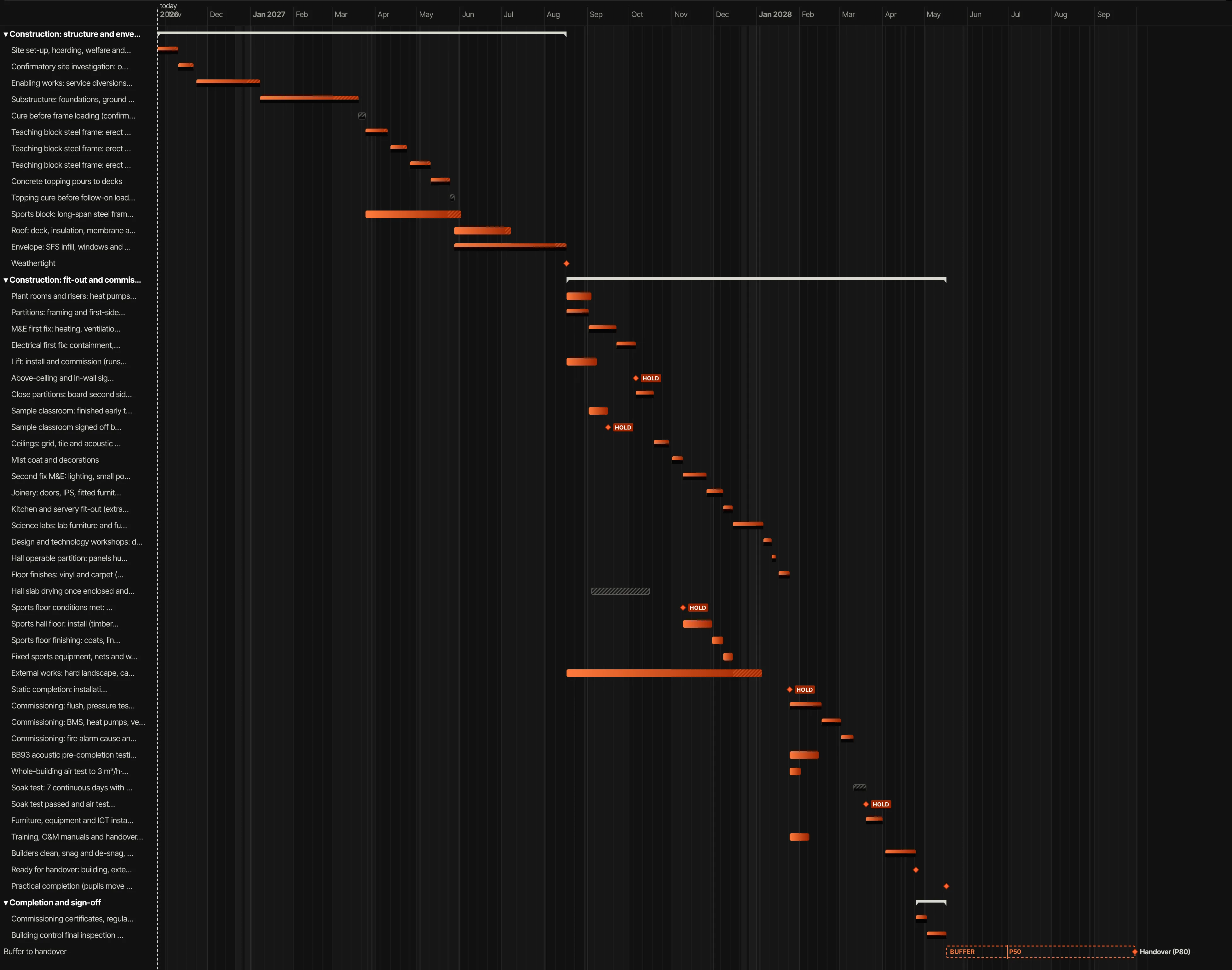
3 things make a secondary longer than a large primary. Science labs, with fume cupboards commissioned and tested to BS EN 14175-4. A sports hall with a long-span roof and a floor that cannot go down until the slab is dry. And longer acoustic testing, because there are more room types and more of them fail first time.
How long does it take from the decision to build to opening?
| Route | Already done when the clock starts | Start on site | Promisable handover (P80) | Total |
|---|---|---|---|---|
| Construction only | Design, planning, approvals and contractor in place | 26 Oct 2026 | 29 Sep 2028 | 23 months |
| Traditional, single-stage tender | Design complete to RIBA Stage 4 | 16 Mar 2027 | 14 Mar 2029 | 29 months |
| Design and build from Stage 4 | Employer’s Requirements written | 21 Jun 2027 | 15 Jun 2029 | 32 months |
| Two-stage design and build from Stage 3 | Concept design only | 15 Feb 2028 | 10 Jun 2030 | 44 months |
The two-stage route carries the planning application, and for a major application in England that now runs well past its 13-week statutory period in most cases (LandTech, from MHCLG data). It also carries design freeze, cost alignment and second-stage pricing. Every one of those months is cheaper than a month on site.
An old hand taught my generation that a month extra pre-contract is worth 6 months on site. I have never seen it proved wrong.
Can a secondary school open in September?
Only if you plan it to. Pupils move at a holiday, and the school needs at least 2 weeks between completion and the move, 4 to be comfortable.
On this programme the P50 is 29 June 2028. The summer break starts about 22 July, so completion is needed by 8 July. The generator gives that a 53% chance. Miss it and the move rolls to October half-term. At the P80, October half-term is the plan.
53%.
That is the most important number in this article. A secondary programmed to finish “in time for September” with no buffer is a coin flip. Lose it and you pay for a term of temporary classrooms and transport, and a governing body that will not believe your next date.
If September is fixed, work backwards from it: the P80 must land by early July, which moves the start on site and every order date in front of it.
Why does a school take longer than an office of the same size?
The DfE contract adds hold points no commercial client asks for: a sample classroom signed off before finishes roll out, a 7-day soak test with every system in automatic, an air test to the DfE’s airtightness target, and BB93 acoustic testing in finished, unfurnished rooms (DfE General Conditions, January 2026). The primary school article explains each one. On a secondary they take longer because there is more building to test.
Then there are sprinklers. At 4 or more storeys, or over 11 m, the DfE requires them, and the generator adds a sprinkler row. Below that it does not, though the policy is under review.
What it looked like on a Gold Medal secondary
Woodmansterne School was a £22m secondary built on a live site next to an operational primary school, with 7 sectional completions. We handed it over 6 weeks and 1 day early, released the ground floor 12 weeks early, and it won the CIOB Construction Manager of the Year Gold Medal in 2019.
It went wrong too. The envelope finished 12 weeks late. The job still finished early, because the finishing sequence was written 3 months before start, the building was tested and commissioned in areas of about 1,000 m², and the buffer was won early and protected. I’ve told the full story in There Are Two Kinds of Planning.
The dates on the Gantt chart were not the difference.
How many people understood the plan, and owned it, was.
If you’re running a secondary, start there.
That way of running a job is now a training programme. Going for Gold is the construction project management training I built from it, taught to a contractor’s own delivery team on their live projects.
What makes a secondary school finish late?
- Late orders. On a 26 October start: teaching block steel by 31 December 2026, lifts by 23 February 2027, roof and windows by 2 April, plant by 1 June, the sports hall floor by 14 September and the science lab furniture by 22 September. Each one ordered late becomes the end date.
- The envelope. It sets when the internals can start. A temporary watertight strategy, planned in advance, is what saved Woodmansterne.
- Weather. This programme carries 63 working days of weather allowance across 2 winters.
- The commissioning tail. 8 weeks from static completion to a passed soak test on this programme, run in series. Squeeze the fit-out and this is where the time gets taken back.
Is a secondary rebuild slower?
Yes, overall. On a rebuild the new school goes up beside the old one, pupils move, then demolition, external works and pitches follow: allow about 40 weeks after occupation, or 56 to promise. Where pupils must decant before work starts, add 8 to 16 weeks of temporary accommodation in front.
In Scotland the few dated secondaries took about 102 weeks on site at P50. That figure is indicative only, but it is the right order of magnitude.
Frequently asked questions
How long does it take to build a secondary school in the UK?
About 20 months on site for a 1,125-place secondary, with about 23 months as the date to promise. From the decision to build, allow 2.5 to 3.5 years depending on the route.
Can a new secondary school be built in a year?
Not a full-size one, conventionally. Even the plan at chosen rates is 81 weeks on site. Smaller schools, phased handovers or offsite construction change the answer: model them in the generator.
Why do secondary schools take longer than primaries?
Size, science labs, a sports hall and longer acoustic testing. The DfE completion requirements are the same, on more building.
When should a secondary school be completed to open in September?
By early July at the latest, with the P80 date before then, not the plan.
How much buffer does a secondary school programme need?
On this example, 96 working days from plan to P80. It looks large because the programme is long. Shown openly, it is the most defensible number on the page.
Build your own secondary school programme
The free construction programme generator builds this whole programme in under a minute: Gantt chart, P50 and P80, buffer, hold points, order-by dates and the September window. Change the floor area, storeys, route or start date and it rebuilds. Download it for Excel and keep it.
Build my secondary school programme →
A September opening is not a date. It is a probability, and you can choose how high it is.
The bottom line: plan to the summer holiday, promise the P80, and win the buffer before you start.
More in this series: how long does it take to build…
a primary school? · a house? · a leisure centre with a pool? · an office building?
Sources
- Free construction programme generator v2.9: every duration, date, order-by date, the holiday window check and the value-based check. Runs made 26 Oct 2026, secondary school defaults, all four routes.
- Constructing Culture research register (Oct 2026): dated English secondaries, about 87 weeks on site at P50 and 100 at P80; Scotland about 102 weeks at P50 (indicative).
- DfE Employer’s Requirements, General Conditions, January 2026.
- DfE Construction Frameworks, Part A: General Conditions (soak test, clause 4.1.7).
- DfE, Construction Framework 2025 handbook.
- Statlog, England’s school sprinkler rethink.
- LandTech, How long do planning applications actually take in 2026?, from MHCLG Q3 2025 data.
- Woodmansterne School: as published on constructing-culture.co.uk in Collaborative Planning Workshops and There Are Two Kinds of Planning.
- Martin, Burrows and Pegg (2006), BCIS duration research, as rebased inside the generator.

Andy Pritchard MCIOB
CIOB Gold Medal, Construction Manager of the Year 2019. Founder of Constructing Culture and author of Going for Gold. About Andy →