
How Long Does It Take to Build a Primary School in the UK?
How long does it take to build a primary school? About 14 months on site for a new two-form-entry school in England, and about 15 months is the date you can safely promise. Add design, approvals and tender and it is 19 months to 3 years from the decision to build. Here is where every month goes, and the one date that matters more than any of them.
Most answers to that question give you one number. It is almost always the plan. And the plan is the date the job is most likely to miss.
I’ve spent 23 years watching jobs get judged against a date nobody ever tested. So we tested one.
We ran a standard primary school through our free construction programme generator: 420 places, 2,350 m² over 2 storeys, steel frame, starting on site on 26 October 2026 in the South of England. It builds the programme activity by activity, then runs it 400 times with every duration moving inside a realistic range. It gives you 3 dates.
| Date | When | Weeks from start on site |
|---|---|---|
| Plan at the chosen rates | 18 Nov 2027 | 55 |
| Likely finish (P50) | 20 Dec 2027 | 60 |
| Promisable finish (P80) | 27 Jan 2028 | 65 |
The plan is what most programmes show. The P50 is the likely finish: half the 400 simulated outcomes finish earlier. The P80 is the date 80% of them beat, and it is the one to put in front of a head teacher. The 40 working days between the plan and the P80 are the buffer. They belong at the end of the programme, where everyone can see them. Not hidden in the activities, where nobody can.
The plan is a target. The P80 is a promise. Only one of them belongs in front of a head teacher.
That 60-week P50 is not a guess. Dated primary schools in England have a median of about 56 weeks on site in our research register, and the DfE model area the tool uses runs about 12% above typical built areas. The published UK duration-from-value curve (Martin, Burrows and Pegg, from BCIS data) lands at about 59 weeks for a school of this value. Different sources, the same answer, all within 4 weeks of each other.
How long does each stage of a primary school build take?
The frame is not where the time goes. A primary school is weathertight about halfway through. The second half is fit-out, testing and the DfE’s own completion requirements.
| Stage | Finishes | Weeks from start |
|---|---|---|
| Site set-up, confirmatory investigation and enabling works | 16 Dec 2026 | 7 |
| Substructure: foundations, ground beams, drainage and slab | 18 Feb 2027 | 16 |
| Steel frame, metal decks and topping cure | 10 Apr 2027 | 24 |
| Roof and envelope to weathertight | 7 Jun 2027 | 32 |
| Fit-out to static completion | 23 Aug 2027 | 43 |
| Commissioning, acoustic and air tests, 7-day soak test | 1 Oct 2027 | 49 |
| Furniture and ICT, snagging, certificates and building control completion | 18 Nov 2027 | 55 |
| Buffer to the promisable handover | 27 Jan 2028 | 65 |
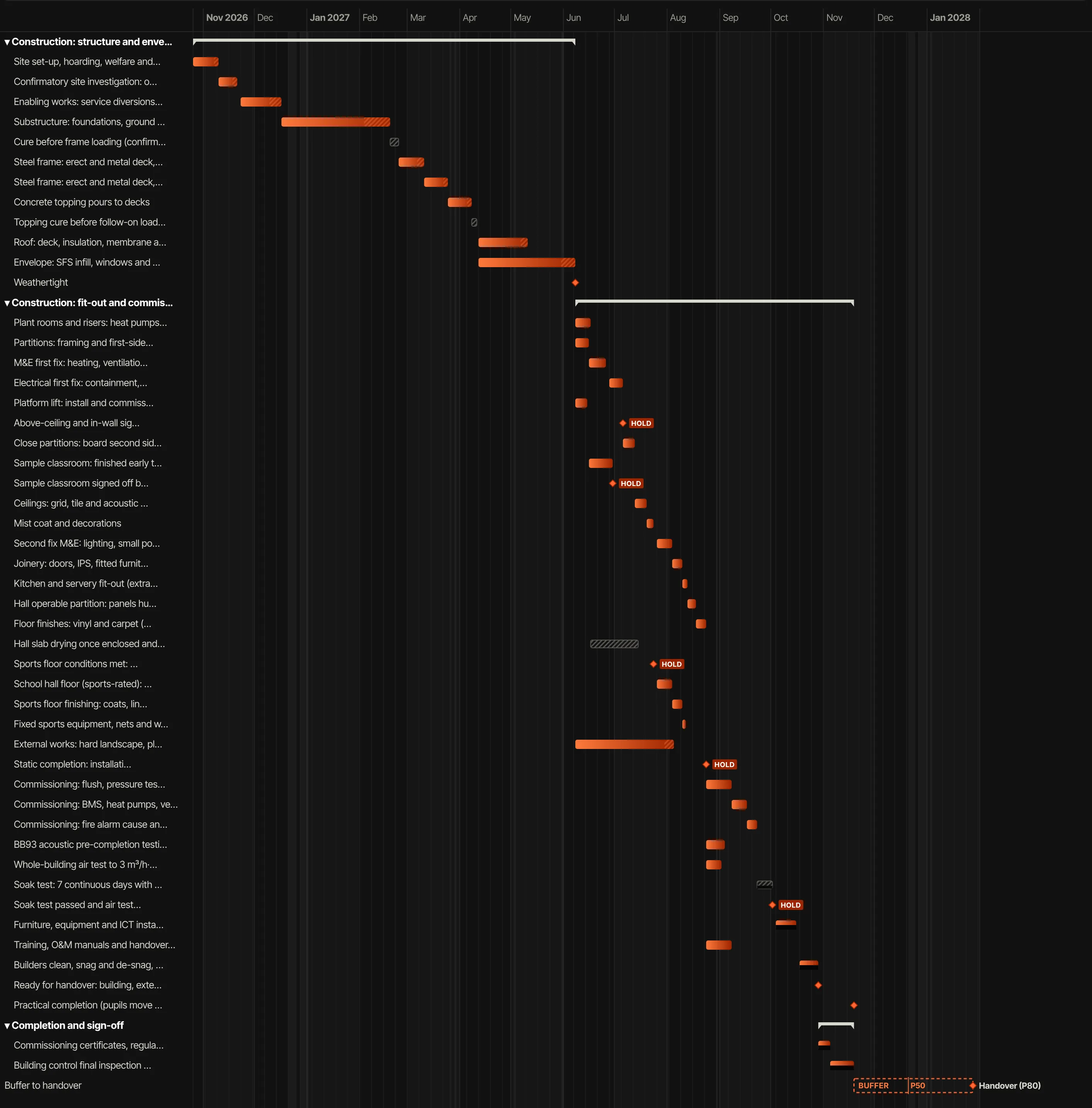
The last 22 weeks of that programme contain almost no building.
They contain checking.
That is the part most first programmes squeeze, and it is the part that cannot be squeezed. A soak test takes 7 days whatever the programme says.
How long does it take from the decision to build to opening day?
Site time is only part of the answer. The route you choose decides how much time sits in front of the first spade, and on the slowest route that is well over a year.
| Route | Already done when the clock starts | Start on site | Promisable handover (P80) | Total |
|---|---|---|---|---|
| Construction only | Design, planning, approvals and contractor in place | 26 Oct 2026 | 27 Jan 2028 | 15 months |
| Traditional, single-stage tender | Design complete to RIBA Stage 4 | 16 Mar 2027 | 7 Jun 2028 | 19 months |
| Design and build from Stage 4 | Employer's Requirements written | 21 Jun 2027 | 5 Oct 2028 | 23 months |
| Two-stage design and build from Stage 3 | Concept design only | 15 Feb 2028 | 5 Oct 2029 | 35 months |
The two-stage route is long because planning sits inside it. A new school is a major application. The statutory period is 13 weeks, but in the third quarter of 2025 only 19% of major applications in England were decided within 13 weeks without an agreed extension (LandTech, from MHCLG data). The generator allows about 26 weeks. Building control full plans add a statutory 5 weeks on every route that has not already cleared them.
Most English schools now go through the DfE’s Construction Framework 2025, with a mini-competition or a direct allocation before any of this starts. Put that in front of the table too.
Why does a school take longer than an office of the same size?
Because the DfE contract adds steps no other client asks for. Each one is a hold point: work stops until it is signed off. Leave one off the programme and you find it on site, which is the most expensive place to find anything.
- The sample classroom. One classroom is finished early, to completion standard, with furniture and working blinds. The client signs it off before finishes roll out across the building (DfE General Conditions, January 2026).
- The soak test. Seven continuous days with every system in automatic, as if the school were occupied. It cannot start until commissioning is finished, and nothing can shorten it.
- The air test. The whole building tested against the DfE's airtightness target, with time to fix and retest.
- Acoustic testing to BB93. Finished, unfurnished rooms with the ventilation running. First-round failures happen, so the programme allows a retest.
- The hall floor. A sports-rated floor needs a watertight hall, wet trades finished, heating stable at 13 °C or more and the slab at 75% relative humidity or below. In this programme the slab gets four weeks of drying once enclosed. Test it. Don't assume it.
- The live site. Many new schools are built next to the one they replace. Segregated routes, gate times and safeguarding are on the programme from day one.
After handover the DfE contract keeps going: 12 months of seasonal commissioning and 15 months of performance monitoring. None of it delays opening. All of it needs your team still answering the phone.
When can pupils move in?
This is the question that matters most, and almost no programme answers it. Pupils move at a holiday. The school needs at least 2 weeks between completion and the move, and 4 is typical.
At the P50 of 20 December 2027, the earliest move is February half-term. That needs completion by 29 January 2028, and the generator gives it an 82% chance. Miss it by a week and the move rolls to Easter: 2 more months of temporary classrooms, rent and transport, and a head teacher who stops trusting your dates.
Plan the completion to the holiday. Not the other way round.
If the window is fixed, the start date and the order dates are the only things you control. Use them.
What makes a primary school finish late?
The ground, the orders and the end. In the 2019/20 UK industry survey, the last of its kind, about 60% of projects finished on time (Glenigan and CITB, via Construction Plant News). So about 4 in 10 did not. Primary schools fail in predictable places, and predictable means you can plan for it.
- Late orders. On a 26 October start, the steel frame must be ordered by 2 December 2026, the windows and roof by 15 February 2027, the heat pumps and ventilation plant by 23 March and the sports floor by 31 May. A package ordered late becomes the end date.
- The ground. Confirmatory investigation, service diversions and drainage take the first seven weeks. Findings there can change the design, which is why the generator gives them wide ranges.
- Winter. This programme carries 40 working days of weather allowance, most of it in the substructure months. A spring start carries less.
- The commissioning tail. Witnessing, certificates and the soak test run in series. When fit-out slips, this is where the time gets taken from, and it gives it back with interest.
I learned the cost of a thin buffer on a £12m primary school. Mechanical ventilation was added at Stage 4, so the storey heights went up to fit it. That made the frame panels too big for the lorries. Each one was split into 4, every split meant more time on the hook, and the frame package grew from 10 weeks to 22. We had 2 weeks of buffer, so that was a 10-week critical path delay. We recovered it with temporary waterproofing on every floor, so the internals could start early, and a drylining partner who put up to 60 operatives on the job. We handed over 2 days late, with no claim.
Late orders, the ground, winter and the commissioning tail are planning problems before they become site problems. If you want your project managers to catch them early, Going for Gold trains them to plan this way, on their own live jobs.
Does it take longer in Scotland or Wales?
Yes. Dated primaries in Scotland and Wales run about 8 weeks longer on site, and the generator adds that when you pick the region. Each nation has its own approval route too: a building warrant in Scotland, council building control in Northern Ireland. And the holidays move, with earlier summer breaks in Scotland and Northern Ireland.
Is a rebuild or a modular school faster?
Not overall. A rebuild on the same site is slower: the new school goes up first, pupils move in, then the old building comes down and the external works finish as a second phase. That second phase is about 26 weeks, or 34 to promise.
A volumetric modular primary can run about 32 weeks on site, on the suppliers’ own evidence. Factory time, design freeze and transport still sit in front of that. Compare total time, not site time, or you are comparing a brochure with a programme.
Frequently asked questions
How long does it take to build a primary school in the UK?
About 14 months on site for a two-form-entry primary, with about 15 months as the date to promise. From the decision to build, allow 19 months to 3 years depending on the procurement route.
How long does it take to build a one-form-entry primary?
Less, but not half. Durations grow more slowly than floor area: enter your own floor area in the generator to see it.
What is the longest part of building a school?
The fit-out and the completion tests. The building is weathertight about halfway through; commissioning, the 7-day soak test and the DfE tail fill most of the second half.
When should a new primary school be completed?
At least two weeks before the holiday the pupils move in, and four is safer. Plan the completion to that window.
How much buffer should a school programme have?
Enough to reach the P80 date from the plan: 40 working days on this example. Show it at the end of the programme, where everyone can see it.
Build your own primary school programme
Every number in this article came from a single free tool. Change the floor area, storeys, region, start date or route, and the free construction programme generator rebuilds the whole programme in under a minute: Gantt chart, P50 and P80, buffer, hold points, order-by dates and the holiday window. Download it for Excel and keep it.
If you’re running a school job and the date you’ve been handed has never been tested, test it before you sign up to it.
Build my primary school programme →
A school is finished when the pupils sit down in it. Not when the contractor leaves.
The bottom line: build to the holiday, promise the P80, and protect the last 22 weeks.
More in this series: how long does it take to build…
a secondary school? · a leisure centre with a pool? · a house? · an office building?
Sources
- Free construction programme generator v2.9: every duration, date, order-by date, the holiday window check and the value-based check. Runs made 26 Oct 2026, primary school defaults, all four routes.
- Constructing Culture research register (Oct 2026): dated primary schools in England, median about 56 weeks on site; Scotland and Wales about 8 weeks longer.
- DfE, Construction Framework 2025 handbook, published 23 Mar 2026.
- DfE Employer's Requirements, General Conditions, January 2026: sample room (clause 1.4.11).
- DfE, BB103 Area Guidelines for Mainstream Schools: model areas.
- LandTech, How long do planning applications actually take in 2026?, 2 Mar 2026, from MHCLG Q3 2025 data.
- Construction Plant News on the Glenigan and CITB KPI report 2019/20: about 60% on time.
- Martin, Burrows and Pegg (2006), BCIS duration research, as rebased inside the generator.

Andy Pritchard MCIOB
CIOB Gold Medal, Construction Manager of the Year 2019. Founder of Constructing Culture and author of Going for Gold. About Andy →