
How Long Does It Take to Build a Leisure Centre With a Swimming Pool?
How long does it take to build a leisure centre? With a 25 m pool, about 18 months on site and 22 to promise. Without a pool it is about a year. With a 50 m pool it is 2 years or more. The pool is the reason, and more labour cannot shorten it.
A swimming pool is a building that has to hold water before it can be finished. That one fact sets the programme. The tank is tested, rendered, tiled and filled on fixed intervals, and no gang size, overtime or acceleration plan will compress them.
The concrete doesn’t care about your completion date.
We ran 3 standard leisure centres through our free construction programme generator, each at its default size, starting on site on 26 October 2026 in the South of England.
| Leisure centre | Size | Plan | Likely finish (P50) | Promisable finish (P80) |
|---|---|---|---|---|
| No pool: 6-court hall, gym, 2 studios | 3,000 m² | 50 weeks | 54 weeks (9 Nov 2027) | 66 weeks (1 Feb 2028) |
| 25 m pool: 6 lanes, learner pool, 4-court hall, gym | 3,900 m² | 74 weeks | 80 weeks (10 May 2028) | 95 weeks (21 Aug 2028) |
| 50 m pool: 8 lanes, boom and movable floor, 5-court hall | 6,100 m² | 93 weeks | 103 weeks (16 Oct 2028) | 119 weeks (2 Feb 2029) |
The 25 m pool centre takes 30 more weeks to promise than the dry centre, for only 900 m² more building. The weeks are in the water.
These numbers follow completed schemes, not formulae. Dated UK 25 m pool centres in our research register take about 80 weeks on site at P50 and 95 at P80. More than half of those with published plans finished at least 4 weeks late, and the reported causes include leaks found at the first fill and late M&E commissioning. The published UK duration-from-value curve for pools rests on 13 projects and runs well above completed centres, so the generator switches it off for pools and tells you why.
Why does a swimming pool take so long to build?
Because the pool runs on technical intervals, and each one waits for the last. Here is the 25 m pool’s sequence from the generator, in weeks from start on site.
| Step | Rule | Finishes | Week |
|---|---|---|---|
| Pool tank and balance tank structure | Water-retaining reinforced concrete | 7 Apr 2027 | 23 |
| Concrete age before the water test | 28 days | 5 May 2027 | 27 |
| BS 8007 water test of the bare tank | Fill at 2 m a day at most, stabilise 7 days (21 for a 0.2 mm crack-width design), then 7 days of readings; the drop must not exceed 1/500 of the depth or 10 mm | 21 May 2027 | 30 |
| Shell age before render | 42 days from tank complete | 19 May 2027 | 30 |
| Render cure before tiling | 21 days | 22 Jun 2027 | 35 |
| Pool hall weathertight and heated | Tiles cannot go on in a cold, wet hall | 9 Aug 2027 | 41 |
| Tank and surround tiling | About 650 m² | 20 Sep 2027 | 47 |
| Grout cure before filling | 21 days | 14 Oct 2027 | 50 |
| First fill of the finished pool | 0.75 m a day at most, often limited by the mains | 2 Nov 2027 | 53 |
| Heat-up, dye test, microbiological sample, pool accepted for use | PWTAG, PAS 39 and HSE HSG179 | 22 Nov 2027 | 56 |
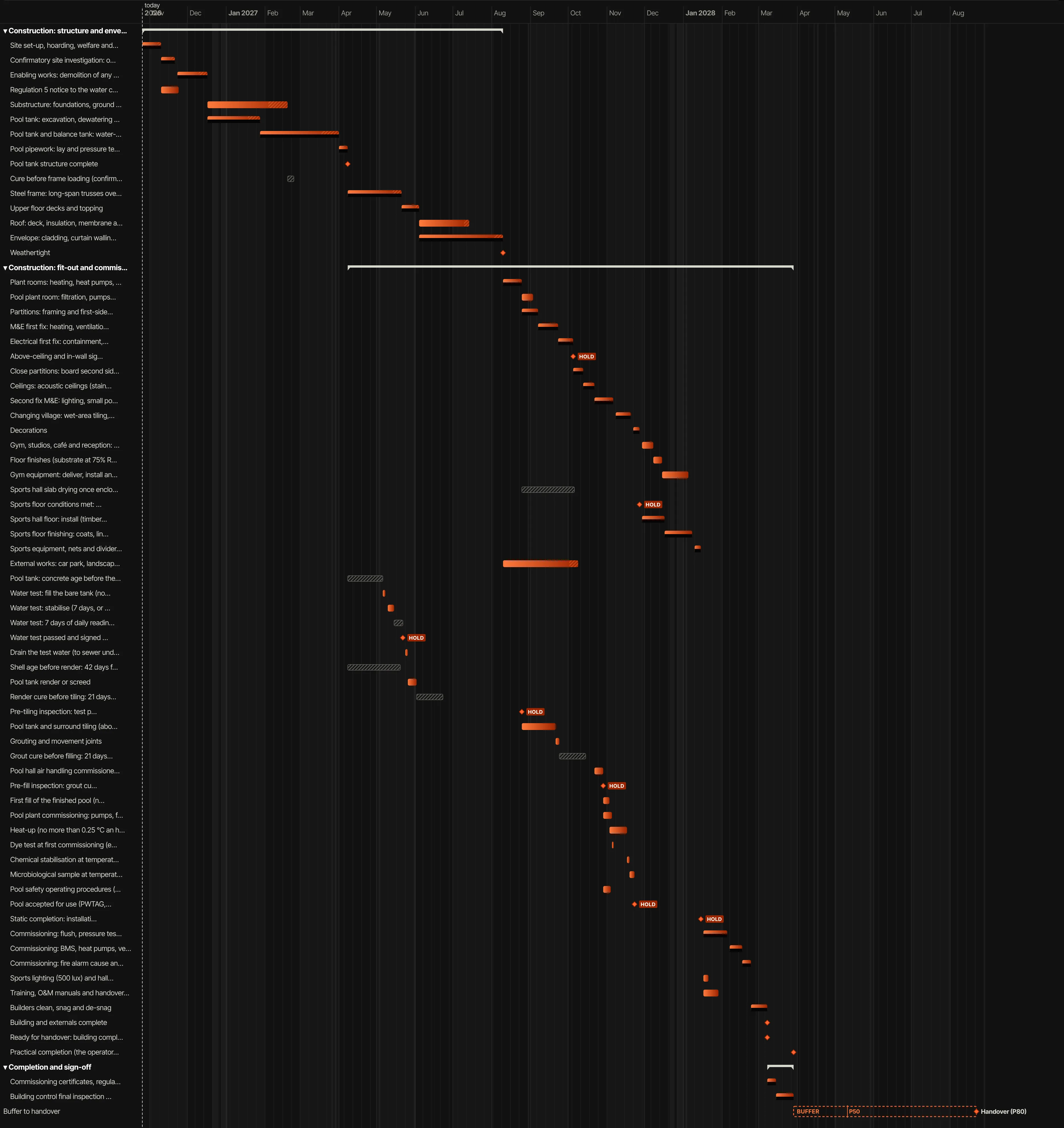
The tiling intervals come from tile adhesive manufacturers’ guidance citing BS 5385-4: about 6 weeks from tank structure to render, 3 weeks from render to tiling, 3 days from fixing to grouting and 3 weeks from grouting to filling. Shorten any of them and you risk tiles coming off. That means draining the pool.
The water test is the most important hold point on the job. The generator places it about 40% of the way from start on site to completion. Completed UK pools range from about 30% to 60%. The later it falls, the less room you have to repair.
Test the tank while there is still time to fix it. A late test is just a later way of finding out.
What happens if the pool leaks?
A leak found at the first fill costs 8 to 20 weeks per repair cycle: drain, find, repair, cure, refill, retest. That is why the generator checks how far the first fill sits from completion. In this programme it finishes 21 weeks before completion; the generator flags anything under 4 weeks.
The fill rate matters too. At 0.75 m a day, and with many mains supplies unable to deliver even that, a 25 m pool takes days to fill and a 50 m pool takes a week or more. Agree the bulk fill and any drain-down with the water company early. Under regulation 5 of the Water Supply (Water Fittings) Regulations 1999, a pool over 10,000 litres that is topped up automatically from the mains needs notice to the water company, which has 10 working days to respond before work starts.
Why are 50 m pools slower still?
Scale, and the moving parts. A 50 m pool has about 2,500 m² of tiling, nearly 4 times the 25 m pool’s, plus a boom and a movable floor that need a design freeze by RIBA Stage 4. They carry the biggest leak-at-fill risk on the job. Only a handful of community 50 m pools have published dates, so treat the generator’s 103 weeks at P50 and 119 at P80 as indicative.
How long does a leisure centre without a pool take?
About a year on site, and the sports hall floor sets the finish. A sports floor needs the hall watertight, wet trades finished, heating stable at 13 °C or more, the slab at 75% relative humidity or below and the walls at 8% or below. The generator allows 6 weeks of slab drying once the hall is enclosed and heated. A slab can take months.
Test it. Don’t assume it.
Size moves the answer more than for most buildings. Small halls (4 courts, under 2,000 m²) run about 38 weeks on site. Large centres (8 courts or more) run about 74. Athletics tracks and pitches add 20 to 30 weeks: run them as a separate stream.
How long from the decision to build to opening day?
For the 25 m pool centre:
| Route | Already done when the clock starts | Start on site | Promisable handover (P80) | Total |
|---|---|---|---|---|
| Construction only | Design, planning, approvals and contractor in place | 26 Oct 2026 | 21 Aug 2028 | 22 months |
| Traditional, single-stage tender | Design complete to RIBA Stage 4 | 16 Mar 2027 | 9 Feb 2029 | 28 months |
| Design and build from Stage 4 | Employer’s Requirements written | 21 Jun 2027 | 15 May 2029 | 31 months |
| Two-stage design and build from Stage 3 | Concept design only | 15 Feb 2028 | 11 Apr 2030 | 42 months |
Then there’s the operator, because practical completion is not opening day. An operator usually needs about 3 weeks after completion to open a pool centre, and up to 10 to be safe. An outside operator opening a dry centre usually needs about 8 weeks (4 to 12); an in-house team about 2. Put that on the programme. And on the press release.
What makes leisure centres run late?
- A leak at the first fill. 8 to 20 weeks per cycle. Keep the water test early and the first fill well clear of completion.
- Pool plant and air handling. The pool hall dehumidifying air handling, filtration, dosing and UV plant are long-lead and must be running before tiling and filling. On a 26 October start the generator says order the pool hall air handling and heating plant by 4 May 2027 and the pool plant by 30 June.
- The ground. Pool tanks sit deep. Excavation, dewatering and archaeology findings can change the design, so the generator gives the tank excavation a wide range.
- Commissioning in a humid building. Late M&E commissioning is one of the most reported causes of late pools. It cannot start until the pool is accepted and the hall is at temperature.
If you’re planning a pool, put the water test, the first fill and the plant orders on the programme before you put a finish date on anything.
Most pool programmes go wrong at a desk, months before anyone gets wet. That planning craft is what our project management training for contractors teaches.
Frequently asked questions
How long does it take to build a leisure centre in the UK?
About 12 to 15 months on site without a pool, 18 to 22 months with a 25 m pool, and 24 to 27 months with a 50 m pool, at typical community sizes.
How long does it take to build a public swimming pool?
The pool itself sets about 33 weeks of the programme, from tank structure to acceptance, on intervals that cannot be shortened. A full 25 m pool centre takes about 18 months on site.
Can you speed up a swimming pool build?
Not the pool. The water test, render, tiling and grout cure intervals are fixed. What you can do is start the tank early, order the pool plant early and keep the first fill well before completion.
How long is a pool water test?
About 2 to 4 weeks for the bare tank under BS 8007: fill, stabilise for 7 or 21 days, then 7 days of readings. A failure means repair and a full retest.
How long after completion does a leisure centre open?
About 3 weeks for a pool centre, up to 10 to be safe. About 8 weeks for a dry centre with an outside operator.
Build your own leisure centre programme
The free construction programme generator builds all 3 of these in under a minute, with the full pool sequence, the water test check, the buffer, hold points and order-by dates. Change the size, region, route or start date and it rebuilds. Download it for Excel and keep it.
Build my leisure centre programme →
You cannot argue with a pool. It holds water or it doesn’t, and it tells you on its own timetable.
The bottom line: test the tank early, protect the intervals, and promise the P80, not the plan.
More in this series: how long does it take to build…
a primary school? · a house? · a secondary school? · an office building?
Sources
- Free construction programme generator v2.9: every duration, date and order-by date, the pool programme check and the value-based check. Runs made 26 Oct 2026 for the three leisure types, all four routes.
- Constructing Culture research register (Oct 2026): dated UK dry centres about 54 weeks at P50 and 66 at P80; 25 m pool centres about 80 and 95; community 50 m pools about 104 and 120 (Games venues excluded, indicative).
- Sport England, swimming pools design and cost guidance: model centre sizes and sports floor conditions.
- BS 8007 water-tightness test, as set out in the generator’s hold points; tile adhesive manufacturers’ guidance citing BS 5385-4; PWTAG, PAS 39 and HSE HSG179 for pool acceptance.
- Water Supply (Water Fittings) Regulations 1999, regulation 5 (legislation.gov.uk).
- Martin, Burrows and Pegg (2006), BCIS duration research, as rebased inside the generator (switched off for pools).

Andy Pritchard MCIOB
CIOB Gold Medal, Construction Manager of the Year 2019. Founder of Constructing Culture and author of Going for Gold. About Andy →