
How Long Does It Take to Build a House in the UK?
How long does it take to build a house in the UK? About 8 months on site for a 2-storey new-build, from the first dig to the completion certificate, and about 10 for a bigger self-build. Timber frame saves a few weeks. And the thing that most often sets your move-in date is not the bricklayers. It is a floor drying.
Ask a builder how long a house takes and you will usually hear “about 6 months”. That is roughly how long the building work takes.
It is not when you get the keys.
So we tested it. We ran a standard house through our free construction programme generator: 2 storeys, 100 m², traditional brick and block, starting on site on 26 October 2026 in the South of England. It builds the programme activity by activity, then runs it 400 times with every duration moving inside a realistic range. It gives you 3 dates.
| Date | When | Weeks from start on site |
|---|---|---|
| Plan at the chosen rates | 9 Jun 2027 | 32 |
| Likely finish (P50) | 29 Jun 2027 | 35 |
| Promisable finish (P80) | 2 Jul 2027 | 36 |
Bigger houses take longer, but not in proportion. The generator’s results for the same start date:
| House | P50 | P80 |
|---|---|---|
| 100 m², brick and block | 35 weeks (29 Jun 2027) | 36 weeks (2 Jul 2027) |
| 150 m², brick and block | 38 weeks (20 Jul 2027) | 39 weeks (23 Jul 2027) |
| 200 m², brick and block | 42 weeks (18 Aug 2027) | 43 weeks (25 Aug 2027) |
| 200 m², timber frame | 38 weeks (21 Jul 2027) | 39 weeks (27 Jul 2027) |
Doubling the floor area adds about 7 weeks, not 8 months. Drying, testing and inspections take the same time whatever the size of the house, so duration grows much more slowly than size.
What are the stages of building a house?
Here is the 100 m² house, stage by stage, in weeks from start on site.
| Stage | Finishes | Week |
|---|---|---|
| Site set-up, foundations, masonry to damp-proof course | 24 Nov 2026 | 4 |
| Walls to roof level, both storeys | 16 Dec 2026 | 7 |
| Roof trusses and coverings | 21 Jan 2027 | 12 |
| Windows and doors: weathertight | 28 Jan 2027 | 13 |
| First fix carpentry, electrics and plumbing; pre-plaster inspection | 10 Feb 2027 | 15 |
| Plastering and drying | 15 Mar 2027 | 20 |
| Second fix, kitchen, tiling and decoration | 9 Apr 2027 | 24 |
| Waiting for the ground floor screed to dry | 3 May 2027 | 27 |
| Floor finishes, commissioning, pre-handover inspection | 11 May 2027 | 28 |
| Air test, EPC, certificates and building control completion | 9 Jun 2027 | 32 |
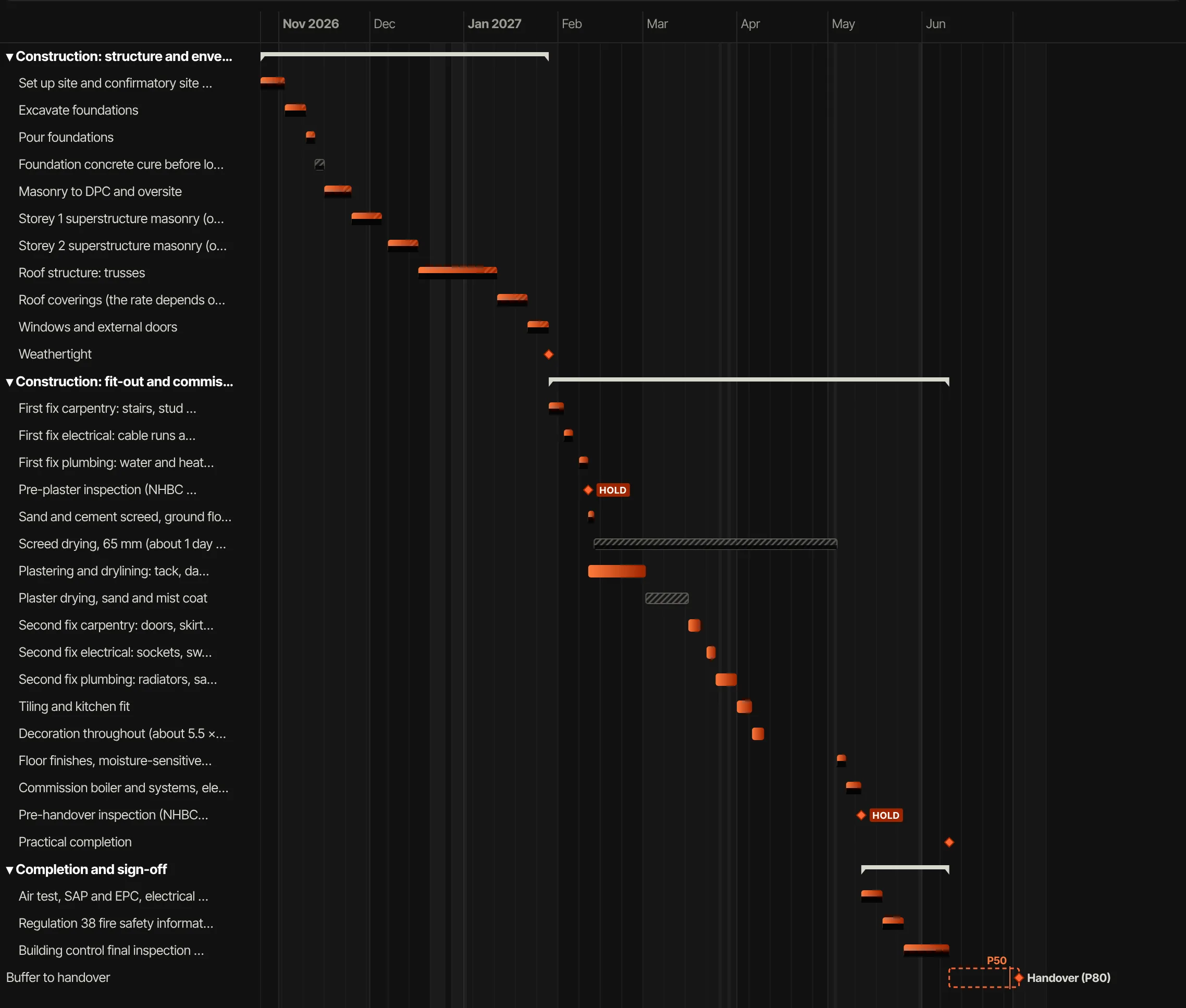
The house is weathertight in about 13 weeks. Fitting it out takes about as long again. Then come 4 weeks of paperwork that nobody puts on the first programme.
Why does the floor screed decide when you move in?
Look at weeks 24 to 27. The house is decorated, the kitchen is in, and nothing can happen. The 65 mm sand and cement screed on the ground floor is still drying.
Screed dries at about 1 day per millimetre up to 50 mm, then about 2 days per millimetre beyond that. A 65 mm screed needs about 80 days before it is dry enough, at 75% relative humidity or below, for vinyl, wood or carpet. Lay those on a wet screed and they lift, cup or grow mould.
On this programme the screed is the critical path. That is not a fault. It is physics. Plan for it from day one: lay the screed as early as you can, heat and ventilate the house, and test it with a hygrometer rather than a guess. Ask whether a faster-drying screed, or a floor finish that tolerates more moisture, suits your house, and check either with the manufacturer.
Drying time is programme time. Treat it as waiting time and it will take your move-in date with it.
How long does it take from buying a plot to moving in?
The build is only part of it. Before the first dig:
- Planning permission. A single new house is a minor application, with a statutory decision period of 8 weeks from validation (Harborough District Council). Many take longer by agreement, and conditions must be discharged before you start.
- Design and building regulations. Full plans approval has a statutory determination period of 5 weeks, or up to 2 months if you agree. You also give building control at least 2 working days’ notice before you start.
- Finding and appointing a builder. On a traditional tender, the generator allows 4 to 8 weeks to price, 2 to 4 weeks to evaluate and 4 to 8 weeks to mobilise.
With the design complete, the generator’s traditional route puts the start on site at 16 March 2027 and the promisable finish at 24 November 2027: about 13 months from the start of tendering. Add the design and planning in front, and 18 months to 2 years from buying a plot to moving in is normal.
Is timber frame faster than brick and block?
Yes, by a few weeks on site. On the 100 m² house the generator gives timber frame a P50 of 16 June 2027 against 29 June for masonry: about 2 weeks. At 200 m² the gap is about 4 weeks.
The time is saved in the shell, which goes up in days instead of weeks and spends less of the winter exposed. Everything after weathertight takes about the same time: the screed, the plaster and the paperwork. Timber frame also needs a frame lead time and a design freeze before the factory starts, so the saving on site can be spent before you ever get there.
Does the time of year matter?
Yes. This programme starts in late October and carries 17 working days of weather allowance, most of it while the walls and roof are going up. The same house started in March carries about 10. If you can choose, start the shell in spring and fit out in autumn.
What makes a house build run late?
- The screed and the plaster. Drying times treated as waiting time, not programme time.
- Late decisions. Kitchens, windows and sanitaryware chosen late arrive late.
- The ground. Trial holes, drains and soft spots found when digging can change the foundations.
- Inspections booked late. The warranty pre-plaster and pre-handover key stage inspections, and building control, all need booking. A missed inspection holds the next trade.
- The paperwork. Air test, SAP and EPC, electrical and gas certificates and the completion certificate take about four weeks on this programme. They are on the critical path.
In the last UK industry survey of its kind, for 2019/20, about 60% of projects finished on time (Glenigan and CITB, via Construction Plant News). A house is not immune.
If you’re a self-builder, make every decision you can before the first dig. The kitchen, the windows, the floor finishes. Every choice left until later is a delivery date you no longer control.
How do I get a programme of works from my builder?
Ask for one. And ask for 3 dates, not 1: the plan, the likely finish and the date they would promise. A good builder will show you the drying times, the inspections and the buffer between their plan and the promise.
A programme with none of those is a hope.
If they don’t have one, build your own in the generator and use it to ask the questions.
Frequently asked questions
How long does it take to build a house in the UK?
About 8 months on site for a two-storey 100 m² house, and about 10 months for a 200 m² self-build. From buying a plot to moving in, allow about 18 months to 2 years.
How long does it take to build a house with timber frame?
About 2 weeks less on site for a 100 m² house and about 4 weeks less at 200 m². The shell is faster; the fit-out is the same.
What takes the longest when building a house?
Fit-out and drying. The house is weathertight in about 13 weeks, but plaster and screed drying, second fix and certificates take the rest.
How long does a floor screed take to dry?
About 1 day per mm up to 50 mm, then about 2 days per mm. A 65 mm screed takes about 80 days. Test it before laying floor finishes.
How long does planning permission take for one house?
The statutory period for a minor application is 8 weeks from validation. Allow longer for agreed extensions and conditions.
Build your own house programme
The free construction programme generator builds a full programme of works for your house in under a minute: Gantt chart, the likely and promisable finish, buffer, inspections and drying times. Change the floor area, storeys, construction type or start date and it rebuilds. Download it for Excel and share it with your builder.
A house is finished when the floor is dry. Not when the builder says so.
The bottom line: start the screed early, plan the paperwork, and ask your builder for the date they would promise.
More in this series: how long does it take to build…
a primary school? · a leisure centre with a pool? · a secondary school? · an office building?
Sources
- Free construction programme generator v2.9: every duration and date, the screed drying rule, inspections and building control steps. Runs made 26 Oct 2026: masonry at 100, 150 and 200 m², timber frame at 100 and 200 m², construction-only and traditional routes.
- Harborough District Council, planning application decision timescales: 8 weeks for minor applications.
- Building Regulations 2010: full plans determination (5 weeks, or 2 months by agreement) and commencement notice, as set out in the generator.
- Construction Plant News on the Glenigan and CITB KPI report 2019/20.

Andy Pritchard MCIOB
CIOB Gold Medal, Construction Manager of the Year 2019. Founder of Constructing Culture and author of Going for Gold. About Andy →