
I Spent the First Ten Years of My Career Certain I Knew Best. It Cost Me a Promotion, It Cost My Projects Time and Quality, and Most of All It Slowed the Progress of the People I Was Meant to Be Leading.
I run Constructing Culture. Before that I spent twenty-two years building in UK construction, fifteen of them on site, and won the CIOB Gold Medal for Construction Manager of the Year along the way. The reason any of that is worth your time is not the medal. It is what I got wrong before I earned it, and what changed when I finally understood the job.

22
years building in UK construction
15
of them on site
Gold Medal
CIOB Construction Manager of the Year
MCIOB
chartered member
What I Actually Believe
Everybody who turns up on a construction site wants to do a good job. Nobody walks through the gate hoping to do bad work. The job of a project manager is to help them build it the easiest, most efficient way it can be built. The thing that lets them do that is time.
Time gives you everything. It gives you quality, because you are not rushing a finish. It gives you safety, because you are not crashing the programme and doubling the labour in the last month, which is exactly when people get hurt. And it gives you profit, because a job that holds its programme is a job that makes money. Get the time right and the rest follows. Lose it, and safety, quality and money fall over together.
I Was the Problem Before I Was the Solution
I need to be honest about where this came from, because the credibility is in the failures, not the wins.
When I was eighteen, a few months into my first job on site, I sat in a client workshop and offered a good idea to solve a logistics problem. The client loved it. I walked out buzzing. My site manager caught me by the collar and told me, in language I will leave out, never to come up with a solution again without giving it to him first so he could present it as his. That was my introduction to how the industry led people. For a long stretch of my career, I became him.
Years later I was running a college reclad and I would not let a talented building manager own his own building, even though he was desperate to and would have done it well. I was determined to write every programme myself. The live job slipped, the quality suffered, and I was taken off the project. Rightly. That mistake cost me a promotion and set my career back about a year. The project was called Nescot.
Then came a twelve million pound primary school in Croydon. A hundred operatives, three site managers, and me trying to run all of it out of my own head. A friend who came to work for me part time asked me a simple question. Why was I a completely different, harder person at work than I was outside it. I did not have a good answer.
"The credibility is in the failures, not the wins."
The Day It Broke
What broke the belief was not a bad year. It was the size of the jobs. A five or ten million pound job, you can just about hold in one head if you are good. A twenty million pound job on a live site with multiple interfaces and a big team, you cannot. The complexity outgrows any one person, however talented they think they are.
Around the same time, I had a 360 appraisal. It was difficult to read and it was completely accurate. I still look at it occasionally to make sure I have not slipped back into old habits. Between that appraisal and my friend's question, something finally landed. I could either learn to run big jobs through other people, or I could stay a small-job builder for the rest of my career. I chose to change.
What Changed
I stopped telling people what to do and started teaching them why, so they could decide for themselves on site. The site manager teaches the supervisor. The supervisor teaches the builder. A teller stays frustrated and overloaded. A teacher frees their own time and builds a team that does not need them in the room.
I gave people real ownership of their areas, down to trainees, matched honestly to what they could handle. I made the same deal with every team I led. Do something well, and the directors hear your name. Get it wrong, and it is my responsibility, and it does not leave the site. That is the deal that makes people brave enough to own their work.
And I learned to react well to bad news, because the moment you shout at the person who brings you a problem is the moment they stop bringing you problems. The same fear that stops a labourer flagging a hazard stops a project manager telling a director the job is late. A hidden problem always gets worse. The practical version was simple. Names on the hard hats so I could speak to people by name. Two walks around the site every day that were only ever for talking. And one question on repeat. What can we do to improve this site.
"A teller stays frustrated and overloaded. A teacher frees their own time and builds a team that does not need them in the room."
The Proof It Works
The job that pulled it all together was a twenty-two million pound, four storey concrete frame secondary school, built on a live school site with seven sectional completions. Woodmansterne. Our own senior leadership would not sign the programme off at first because they thought it was too tight. We handed it over six weeks and one day early, and gave the ground floor back twelve weeks early. We did not get lucky. We won that time before a spade was in the ground, and we built the programme with the supply chain in the room rather than handing it down to them.
The clearest sign it was working was this. In the planning meetings, once the principles were agreed, I would often get up and walk out halfway through. The supply chain I had built up over years would carry on and solve the problem without me. That is when you know you have a real team, when they can do it without you in the room.
It is also the thing I am proudest of for a less obvious reason. The change stuck. The systems we built kept running, and the behaviours we changed kept holding after I left. That is the real test, and it is the one most consultancy fails. I have done the same in reverse, walking into broken jobs. An eleven million pound school, I joined eight weeks into delay, handed over on the contractual date. A ten week delay from a structural frame failure, recovered to two days. Neither was won with a better claim.
The Book
Andy wrote the book on it
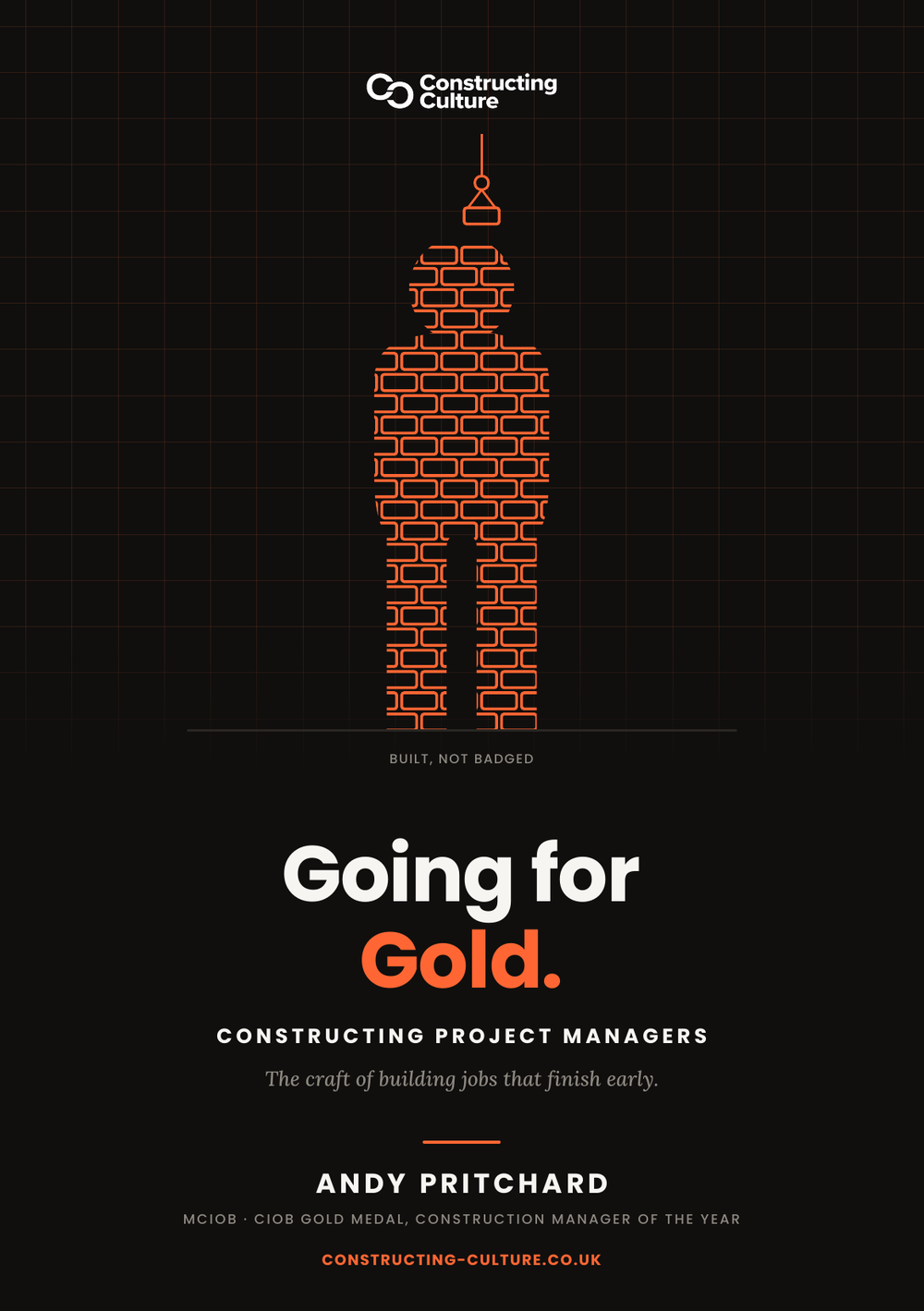
Going for Gold: Constructing Project Managers. 22 years of delivery, the failures included, in thirteen short chapters. Free PDF, no email required.
All royalties from the paperback go to the Lighthouse Construction Industry Charity.
Why Constructing Culture Exists
Here is the thing that bothers me, and the reason I started this. The knowledge that finishes jobs early is not missing from this industry. It is sitting in the heads of a few thousand experienced people, and it walks out of the door every Friday in the minds of those about to retire. We pass it on by accident, if at all. For something this expensive to get wrong, that is a remarkable way to run a profession.
I want to see efficient sites. Sites where the work is ready, the sequence holds, people can do a good day's work and make money, and they go home safe. That is better for the builder, better for the business, and better for the building. So I built Constructing Culture to take what I learned the hard way and make it something other people can actually use. Real change that embeds, and the craft itself, taught to the people who will use it.
Programmes do not build buildings. People do. The programme is just how everybody on the job agrees what to build, and in what order. Get that right, and most of the fights never start.
Programmes do not build buildings. People do. The programme is just how everybody on the job agrees what to build, and in what order. Get that right, and most of the fights never start.

Andy Pritchard MCIOB
Director, Constructing Culture Ltd. CIOB Gold Medal, Construction Manager of the Year.
Take What's Useful. Talk if You Want to.
A lot of what I know is on this site for free, in the writing and in the tools. If you would rather have a conversation, I run a free workshop for contractors. No pitch, no slide deck.